
📌 Key Points
- Hair transplantation corrects wide foreheads in a personalized manner without the scars or general anesthesia required by forehead reduction.
- A forehead is considered wide when the distance between the hairline and the eyebrows exceeds 6 or 7 centimeters.
- Hair transplantation allows for covering receding temples and lowering the hairline simultaneously, unlike surgical reduction by excision.
- Recovery from a microtransplant takes 3 to 5 days, compared to 2 to 3 weeks for forehead reduction.
- Implanted follicles grow continuously and permanently because they are genetically programmed not to fall out.
At Hairfix, we see patients every day who feel that the proportion of their face is affected by a prominent forehead. It is a very common aesthetic concern that can create insecurities when styling your hair or taking photos, but modern medicine offers definitive medical alternatives on how to fix a wide forehead while restoring facial harmony.
What Is Considered a Wide or Large Forehead?
Anatomically, facial proportions are calculated by dividing the face into equal thirds: the upper third extends from the hairline to the top of the eyebrows. In clinical practice, we consider a forehead to be wide when this distance exceeds 6 or 7 centimeters, or when it measures more than the width of four fingers of the patient’s own hand.
This characteristic can be the result of genetic factors or develop over time due to the progressive recession of the hairline caused by androgenetic alopecia.
How to Fix a Wide Forehead: Definitive Solutions
Many people try to disguise the size of their forehead by using bangs, strategic hairstyles, or avoiding pulling their hair back completely. While these styling tricks may work temporarily, they do not solve the root problem so you can wear ponytails or keep your face clear with complete freedom.
For those seeking a permanent change in facial proportions, current medicine offers two main approaches: surgical intervention via forehead reduction (frontoplasty) or follicular restoration with a hair transplant.
Forehead Reduction: Reduction via Surgical Incision
Forehead reduction, also known as frontoplasty, is a plastic surgery procedure that involves excising a strip of skin from the forehead to advance the scalp. It requires general anesthesia, major incisions that leave a scar along the hairline, and a considerably strict physical recovery period.
Hair Transplant: Follicular Restoration Without Invasive Surgery
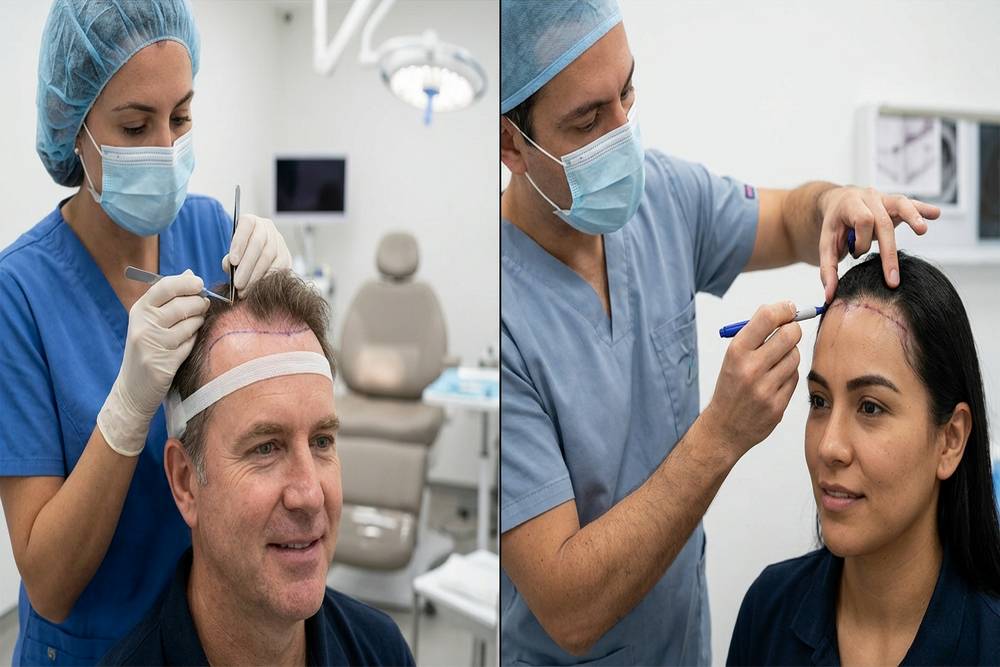
On the other hand, a hair microtransplant allows us to redesign the hairline in a 100% personalized manner, follicle by follicle. It is an outpatient procedure performed under local anesthesia, where we extract follicular units from your own resistant donor area to implant them where density is needed, achieving a completely natural facial frame without visible scars.

Comparative Table: Procedure Evaluation
To help you make the best decision based on your recovery expectations and results, we have summarized the key differences between both procedures to help you decide which option best fits your lifestyle:
| Aspect to Evaluate | Hair Transplant | Surgical Forehead Reduction |
|---|---|---|
| Type of Procedure | Outpatient and minimally invasive | Major invasive surgery |
| Type of Anesthesia | Local anesthesia and sedation | General anesthesia |
| Customization | High (angle-by-angle design) | Limited by skin elasticity |
| Resulting Scar | Imperceptible and distributed | Continuous frontal linear scar |
| Recovery | 3 to 5 days for normal activities | 2 to 3 weeks of strict rest |
Frequently, a wide forehead is accompanied by a receding hairline at the temples. This is a critical point where a hair transplant completely surpasses forehead reduction: surgical reduction can only pull the skin forward in a single block, but it cannot “fill in” the temples or redesign the temporal angles. With a hair microtransplant, we cover the temples and lower the hairline at the same time, achieving a symmetrical, dense, and 100% natural facial frame.
Why Is a Hair Transplant the Most Recommended Medical Alternative?
At Hairfix, we meticulously analyze the elasticity of your skin and the density of your donor area before suggesting a treatment. For the vast majority of our patients, follicular restoration outperforms forehead reduction because it respects the natural anatomy of the face without subjecting the tissues to unnecessary surgical tension.
By opting for a redesign through a microtransplant, we ensure three key anatomical factors for your facial harmony:
- High-Precision Design and Implantation: We recreate the natural cowlicks and variations of your hairline, avoiding the artificial or excessively straight look that scalp advancement by cutting often leaves.
- Natural Growth Direction: By implanting unit by follicular unit, we control the exact angle of each hair so that it grows in perfect harmony with your facial structure.
- Minimally Invasive Technique: By using microsurgical instruments instead of a conventional scalpel, we eliminate major incisions and significantly reduce discomfort during your recovery process.
According to the International Society of Hair Restoration Surgery (ISHRS), follicular restoration techniques registered a patient satisfaction rate exceeding 95% globally. This indicator reaffirms hair transplantation as the modern and safe pathway to achieve a harmonious frontal redesign without visible scars.
Frequently Asked Questions About Hair Transplants to Correct a Wide Forehead
Is the hair transplant procedure painful?
No, we apply high-precision local anesthesia so you do not feel any discomfort during the session. The post-operative process is very manageable and only requires simple cleaning care during the first few days.
Will the implanted hair fall out again?
The follicles extracted from the back and sides of the head are genetically programmed not to fall out. Once established, your new hair will grow continuously for the rest of your life.
When will I see the final results of the redesign?
You will begin to notice new hair growth starting from the third month, reaching full thickness, density, and the final maturation of the design between 9 and 12 months after the procedure.
Take the First Step Toward a Balanced Hairline
Deciding how to fix a wide forehead does not have to be overwhelming when you have proper medical diagnosis and guidance. Evaluating the quality of your donor area and your facial proportions during a professional consultation is the foundation for ensuring results that restore symmetry to your face.
At Hairfix, we have internationally certified staff and first-class facilities at NewCity Medical Plaza, just minutes from the border in Tijuana. If you want to transform your image with a natural and safe design, we invite you to schedule a consultation with our team to define the perfect transplant plan for you.
Sources