
📌Key Points
- Starting at age 35, andropause reduces testosterone levels, triggering the production of DHT, which weakens hair follicles.
- Dihydrotestosterone (DHT) suffocates hair roots, causing progressive follicular miniaturization until the hair stops growing completely.
- Hair mesotherapy provides a preventive approach through direct microinjections of nutrients and DHT blockers into the scalp.
- A hair transplant is the definitive corrective solution, utilizing donor follicles that are genetically immune to DHT.
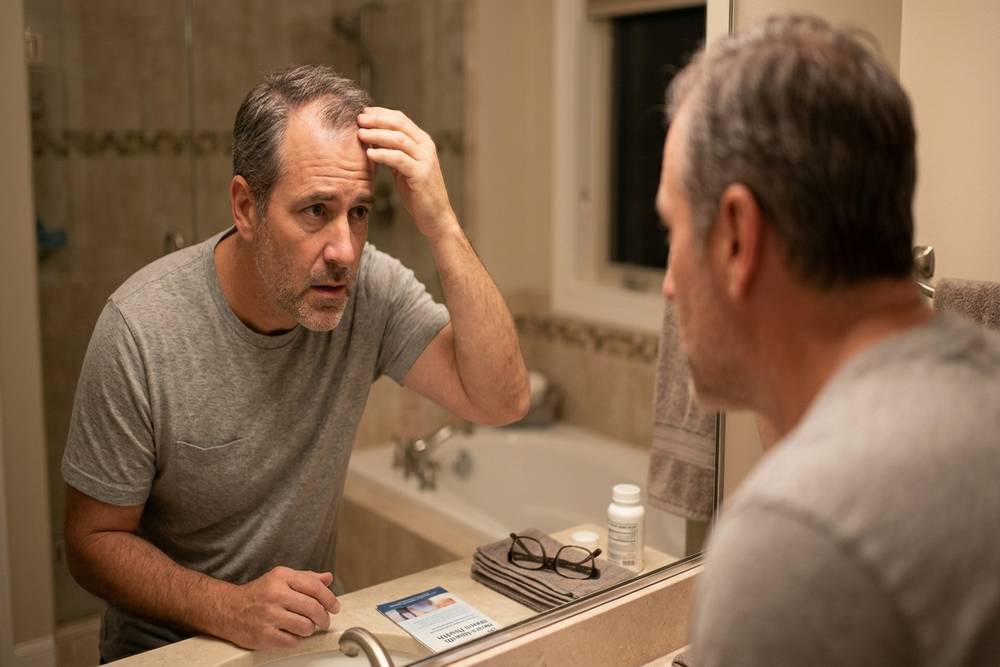
Have you noticed your hair losing density and suspect your hormones might be to blame? Starting around age 35, a silent biological transition begins where follicular impact starts much earlier than expected. This turns hair loss andropause into a very common medical concern among young men in our daily consultation in Tijuana who are seeking solutions to restore their image.
What is andropause and how does it relate to hair loss?
Andropause, also known as late-onset hypogonadism, is the gradual decline in testosterone production in men as they age. Unlike female menopause, this hormonal change does not happen suddenly; testosterone levels decrease by approximately 1% per year starting at age 30.
This clinical shift alters the hormonal balance of the scalp and accelerates follicular weakening in genetically predisposed men. As testosterone decreases, the ratio of other hormones becomes unbalanced, triggering an inflammatory response at the hair root that compromises the natural hair growth cycle.
The science behind the change: Testosterone and DHT
During andropause, free testosterone levels gradually decline by about 1% annually. At the same time, the enzyme 5-alpha reductase converts circulating testosterone into dihydrotestosterone (DHT), a much more potent hormone that binds directly to receptors on the scalp.
Think of the hair follicles on the top of your head as plants receiving an excess of harmful minerals through their watering system. DHT gradually suffocates the root, shortening the growth phase (anagen) and lengthening the resting phase (telogen), causing the hair shaft to grow increasingly thinner until it eventually stops growing.
Is andropause the same as androgenetic alopecia?
No, they are distinct conditions, but they work together to accelerate hair loss. Androgenetic alopecia is a genetic predisposition to hair loss, while the hormonal changes of andropause act as the trigger that “activates” that genetic trait starting at age 35.
When testosterone naturally decreases with age, the body increases the production of DHT (dihydrotestosterone). This hormone weakens and suffocates the hair root, causing hair to grow thinner, shorter, and weaker until it stops emerging altogether.
How to identify hair loss caused by hormonal changes
Detecting warning signs early is crucial to intervening before the hair follicle dies completely. Starting at age 35, hormonal impact manifests through the following symptoms:
- Progressive Thinning (Miniaturization): Hair does not fall out all at once; instead, each new cycle produces a finer, shorter strand, losing its strength and vitality until it turns into nearly imperceptible vellus hair.
- Loss of Density at the Crown: The top of the head gradually thins out, making the scalp visible under direct light.
- Receding Hairline: The temporal entries become progressively more pronounced, forming a classic “M” shape across the forehead.
- Slow Growth and Fragility: Hair takes much longer to grow and breaks easily due to a lack of nutrients at the root.

Effective treatments for hair loss andropause
At Hairfix, we understand that every medical stage requires a precise strategy. Therefore, we divide our approach into two core pillars designed to restore density and vitality to your hair, adapting to the level of hair loss progression:
- Hair Mesotherapy (Preventive Approach): Consists of microinjections of vitamins, essential amino acids, and DHT blockers directly into the dermis of the scalp. It is the equivalent of nourishing and enriching the soil of a garden, ensuring that weakened roots absorb the purest nutrients they need to reactivate and strengthen.
- Hair Transplant (Corrective Approach): The definitive solution for restoring areas where the hair root no longer exists. Using this advanced technique, we individually extract hair follicles from the donor area (back and sides of the head)—which are genetically immune to DHT—and relocate them to bald regions. The result is hair that grows naturally, strongly, and permanently for a lifetime.
Comparative analysis: Preventive vs. Corrective approach
Discover the key differences between the preventive treatment and the corrective solution. This comparison helps you understand the scope, timeline, and expected results for each procedure:
| Criterion | Hair Mesotherapy | Hair Transplant (FUE) |
|---|---|---|
| Objective | Stop hair loss and thicken existing hair. | Restore bald areas with no active follicles. |
| Degree of Alopecia | Initial to moderate (loss of density). | Advanced (receding hairline or thin crown). |
| Results | Progressive, visible from the 3rd session. | Permanent, with natural growth at 12 months. |
| Session Duration | 30 to 45 minutes (no downtime). | One-day procedure with quick recovery. |
At Hairfix, we understand that addressing hormonal hair loss requires both medical precision and patient comfort. Located just 10 minutes from the San Diego border, our hair restoration center welcomes patients from both the United States and Mexico seeking international-grade technology and maximum procedure efficacy.
Frequently asked questions about hair loss in andropause
Can hair loss from andropause be reversed with diet alone?
A balanced diet strengthens the hair fiber, but it cannot stop the metabolic effect of DHT on the follicle. A targeted medical treatment is required to block this hormonal impact at the dermatological level.
Will transplanted hair fall out again due to andropause?
No. Follicles harvested from the back of the head do not have DHT-sensitive receptors, so they retain their genetic memory and continue to grow permanently for the rest of your life.
Regain density and confidence with Hairfix
Facing hair loss andropause does not mean resigning yourself to losing your image. With proper medical guidance and cutting-edge technology, it is entirely possible to stop follicular miniaturization or redistribute your own hair to achieve a dense, firm, and completely natural look.
At Hairfix, we accompany you through every step of the process with personalized diagnostics and advanced hair restoration techniques in Tijuana, located inside the prestigious NewCity Medical Plaza complex just minutes from the border. Take the first step today, schedule your evaluation consultation, and rediscover the best version of yourself backed by internationally certified specialists.
Sources
https://pmc.ncbi.nlm.nih.gov/articles/PMC4674408/
https://pmc.ncbi.nlm.nih.gov/articles/PMC12380480/
https://www.sciencedirect.com/science/article/pii/S0753332221000329