
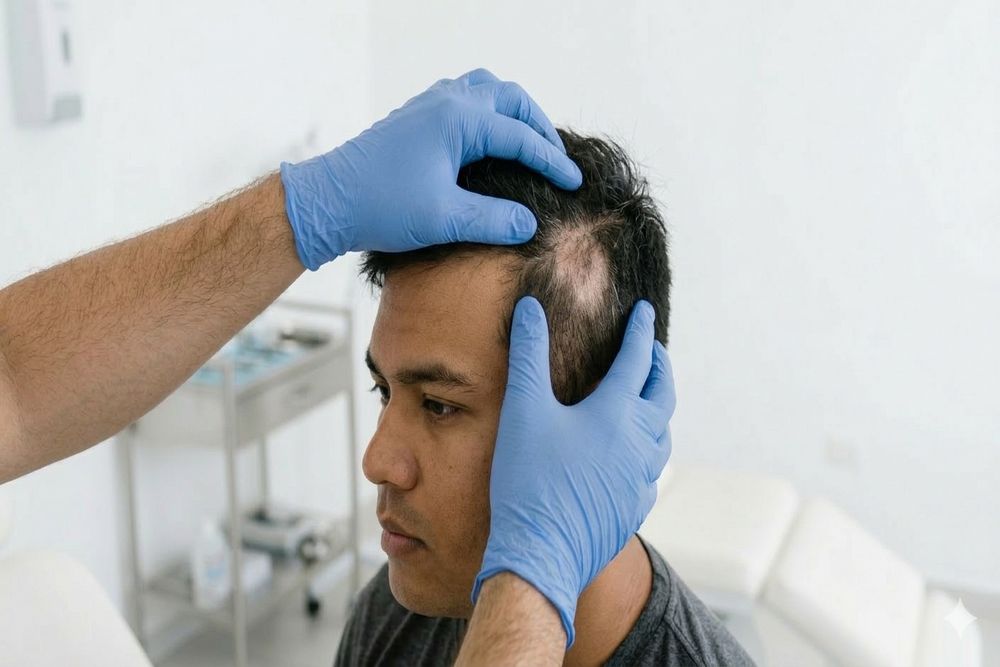
Have you ever noticed a small patch without hair near your temple that seems to form a perfect triangle? You might have thought it was a birthmark or perhaps a scar left behind after a childhood fall.
In the world of hair medicine, this condition actually has a very specific name: temporal triangular alopecia, also known as congenital triangular alopecia (CTA) or Brauer nevus. It’s a benign condition that often worries parents because it commonly appears in children and teenagers.
To give you peace of mind, today we’ll explain everything you need to know about triangular alopecia—and why conventional treatments usually aren’t the solution.
What Is Congenital Triangular Alopecia?
Simply put, triangular alopecia is a benign pattern of non-scarring hair loss. It appears as a patch with little or no hair, or with very fine vellus hair, typically shaped like a triangle, oval, or spear-point.
It is most commonly located on the temples or the sides of the forehead. Although the term “congenital” suggests it is present at birth, it is not always visible right away. It usually becomes noticeable between the ages of 2 and 9, when the rest of the hair grows and the patch becomes more apparent.
Unlike other types of hair loss, the skin in the area looks completely healthy—there’s no redness, scaling, or inflammation. Another key feature is that this condition is static, meaning the small triangular patch does not grow larger over time, but it also does not fill in with hair on its own.
Many patients visit our clinic thinking they have alopecia areata, which is often associated with stress. However, there is an important difference: alopecia areata usually appears suddenly and can move to different areas of the scalp or body, while triangular alopecia is typically present from childhood and remains in the same location throughout life.
Signs That May Indicate Temporal Triangular Alopecia
If you’re wondering whether you might have triangular alopecia, there are a few visual signs that can help distinguish it from other forms of hair loss:
- Location. A patch with little or no hair shaped like a triangle, oval, or spear appears near the temple, close to the hairline.
- Duration. The patch has likely been present since childhood or adolescence and has not grown larger or filled in with hair over time.
- Healthy skin. The skin in the affected area looks normal—there is no redness, scaling, itching, or burning. The hair that grows there is simply very fine and sparse.
Keep in mind that these signs are only informative. A proper diagnosis should always be made by a specialist in hair and scalp conditions.
What Causes Triangular Alopecia?
Despite medical advances, the exact cause of triangular alopecia is still unknown. What we do know is that it is not an infectious or autoimmune disease.
In very rare cases it may be associated with certain genetic conditions, but for most patients at Hairfix, it appears as a minor developmental variation of the hair follicles in that specific area of the scalp.
In simple terms, those follicles were programmed to produce very fine, short, almost invisible hair rather than thick, terminal hair. This doesn’t happen because of a scar or injury—it occurs because the follicles in that area have become miniaturized.

The Importance of an Accurate Diagnosis
One of the key points highlighted in medical literature is that, because this condition is uncommon, it is often mistaken for alopecia areata. As a result, many patients try treatments such as steroid creams or injections, which can be effective for alopecia areata but do not work for triangular alopecia.
At Hairfix, we use polarized light trichoscopy, a diagnostic tool that allows us to examine the hair follicles in detail. It helps us confirm that the follicular openings are normal and that there is no inflammation, which tells us we are dealing with triangular alopecia rather than an immune-related hair loss condition.
This distinction is important because in triangular alopecia, the follicles are permanently miniaturized. Since it is not a disease, it does not require medical treatment, and topical lotions will not change the structure of the follicle.
“I’ve Tried Everything—Why Won’t Hair Grow There?”
It’s very common for patients to try Minoxidil, oils, or stimulating shampoos in an attempt to regrow hair in that area.
But here’s the honest truth: you can’t “wake up” a follicle that simply doesn’t have the structure needed to produce thick hair. Spending money on temporary solutions will not deliver the results you’re hoping for.
Hair Transplant: The Treatment for Triangular Alopecia
At Hairfix, we understand that the only permanent way to correct this patch is through a specialized hair transplant.
Because the affected area is usually small and well defined, the procedure is not only highly successful but also quick and minimally invasive.
To achieve this, we use a micrografting technique, which involves transplanting healthy hair follicles from the back of the scalp—where the hair is genetically stronger—directly into the triangular area.
Our medical team focuses on three key principles to ensure your satisfaction:
- Natural-looking results. At Hairfix, we carefully design the direction and angle of each graft so it blends seamlessly with the natural flow of your hair at the temples. The result looks so natural that no one will be able to tell a procedure was performed.
- No visible traces. Thanks to micro-precision tools, the procedure leaves no visible scars or marks, allowing you to wear your hair as short as you like without worry.
- Restoring facial balance. By restoring hair in the temples, we help bring balance back to the frame of your face. This subtle change can make a noticeable visual difference, giving you a more youthful, harmonious, and confident appearance.
Because the area is small and the skin is healthy, the transplanted follicles adapt extremely well. Today, this is the only treatment that consistently provides a long-lasting and aesthetically satisfying result.
What to Expect After the Procedure
Recovery after a hair transplant is simple and minimally disruptive to your daily routine. Within a few months, the transplanted hair will begin to grow with the same strength and characteristics as the rest of your hair.
That small patch that once bothered you will gradually disappear, allowing you to style your hair freely and confidently.
Medical Tourism: World-Class Hair Restoration in Tijuana
At Hairfix, we have become a trusted destination for patients from the United States and Canada seeking high-quality hair restoration specialists.
Our strategic location in Tijuana, Mexico, allows us to offer advanced technology—such as micrografting and the DHI technique—at a much more accessible cost than clinics in the U.S., without compromising medical quality or safety.
If you’re traveling from across the border, our team is ready to provide a comprehensive medical tourism experience, with guaranteed results and bilingual care.
Restore the Balance and Confidence of Your Profile
Triangular alopecia doesn’t have to be a permanent mark on your appearance. At Hairfix, we specialize in restoring density in those stubborn areas with results that look—and feel—completely natural.
If you’re tired of trying to hide that patch near your temples, it may be time to explore a lasting solution based on advanced hair science.
Schedule your consultation with Hairfix Mexico today and discover how we can help you.