
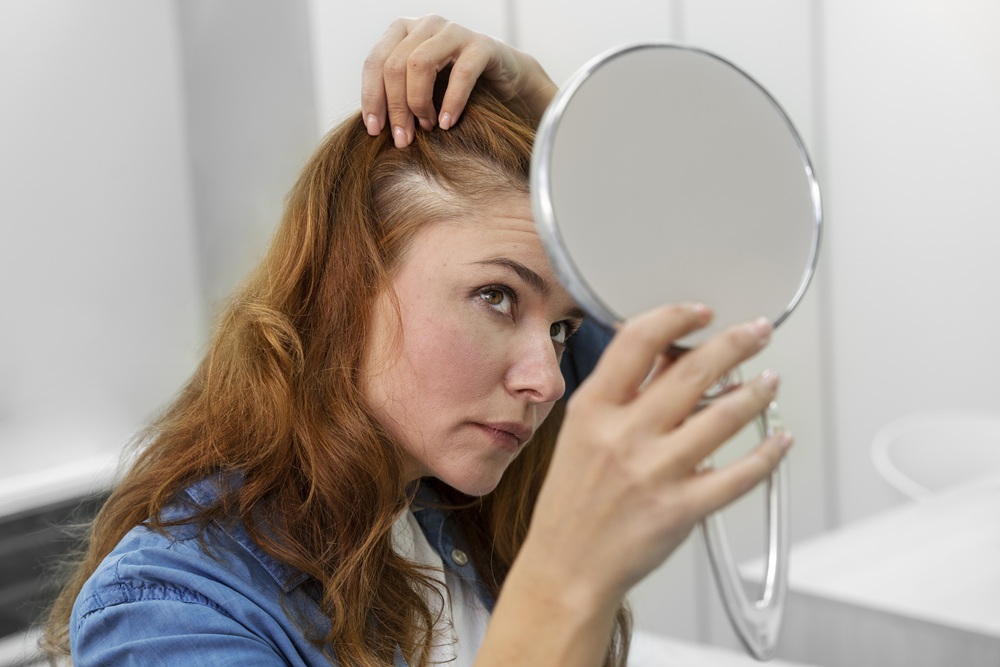
Have you noticed that your hair doesn’t look the same anymore—that your part seems wider or you’ve lost volume on the top of your head? You’re not alone. Many women go through this without fully understanding what’s happening.
This is where the Ludwig scale becomes a key tool for understanding female hair loss. It allows us to classify hair thinning in women, especially when it’s related to hormonal or genetic factors. More importantly, it helps determine where you are in the process and what can be done to improve your hair.
How does the Ludwig scale work?
Unlike male pattern hair loss, which often starts at the hairline, in women the density gradually decreases across the top of the scalp. In many cases, it goes unnoticed at first.
The Ludwig scale is a clinical classification system used to evaluate female pattern hair loss based on scalp density reduction. It divides this progression into three stages. Each one reflects the level of thinning and helps guide the most appropriate treatment approach.
Stages of the Ludwig scale
Understanding your stage isn’t something to fear—it’s the first step toward taking action.
How to identify hair loss based on the Ludwig pattern
Many patients come in thinking it’s “just stress” or that hair shedding is normal. While some shedding is expected, there are clear signs you shouldn’t ignore.
For example, if you feel like your hair no longer has the same volume or you’re styling it differently to cover certain areas, you may be experiencing a pattern consistent with the Ludwig scale.
Other common signs include:
- Thinner hair on the top of the scalp
- Difficulty maintaining your usual hairstyle
- Increased scalp visibility
- A noticeable decrease in density when you touch your hair
These changes are usually gradual, which is why early detection makes a big difference.
How is the Ludwig scale used in diagnosis?
In consultation, the Ludwig scale is one of the first tools we use to evaluate hair loss in women. Through clinical observation, we analyze the distribution and degree of thinning on the top of the scalp to classify the case into one of its three stages.
In addition, this scale helps us identify whether there is a pattern consistent with androgenetic alopecia and define the starting point for treatment.
| Stage | What’s happening to your hair | How it looks |
|---|---|---|
| Ludwig I | Hair begins to thin on the top of the scalp | You notice less volume and a slightly wider part |
| Ludwig II | Hair density decreases more noticeably | The scalp becomes visible under light |
| Ludwig III | Significant hair loss in the upper scalp area | Larger areas with minimal coverage |
However, it’s important to understand that the Ludwig scale does not replace a complete medical diagnosis. Instead, it is part of a comprehensive evaluation that considers your medical history and the progression of hair loss.
Why does female hair loss occur?
It’s estimated that 1 in 3 women experiences some degree of androgenetic alopecia during their lifetime, especially after the age of 40, when its prevalence increases. Several factors can contribute to this condition, including:
- Hormonal changes (menopause, postpartum, polycystic ovary syndrome)
- Genetic predisposition
- Prolonged physical or emotional stress
- Nutritional deficiencies
- Disruptions in the hair growth cycle
It’s important to note that not all hair loss is androgenetic. Other conditions, such as telogen effluvium, can present similarly, which is why a proper diagnosis is essential.
Treatment options based on the Ludwig stage
Not all patients require the same approach. The Ludwig scale helps personalize treatment based on how advanced the condition is.
| Stage | Treatment goal | Recommended options |
|---|---|---|
| Ludwig I | Slow hair loss and strengthen follicles | Scalp mesotherapy, supplements, topical treatments |
| Ludwig II | Restore density and stimulate growth | Mesotherapy, regenerative therapies, combined protocols |
| Ludwig III | Restore areas with low density | Hair transplant with DHI technique + maintenance treatments |
In a case of Stage I Ludwig’s alopecia, how long does it typically take to see a visible widening of the parting if no treatment is started?
Hair loss in women can vary considerably, as it depends on multiple factors such as the patient’s age, the specific cause of the alopecia, and whether there are any underlying conditions, such as an adrenal gland disorder or other imbalances. Unlike men, who typically exhibit more defined patterns, the course of hair loss in women is much more variable, so each case must be evaluated individually. Therefore, it is essential to identify the problem at an early stage (Stage One), as this is the ideal time to investigate the cause, establish an accurate diagnosis, and determine an appropriate treatment to prevent the progression of alopecia.
Hairfix Tip
One of the most common mistakes is waiting for hair loss to “get worse” before taking action. The reality is that the earlier you start treatment, the better the results. Even in early stages, treatments like mesotherapy can significantly improve hair health and slow progression.
Treatments for female hair loss
At Hairfix, we understand that hair loss is not just cosmetic—it’s emotional. That’s why our treatments focus on natural, progressive results tailored to each patient.
Scalp mesotherapy
This is one of the most effective options for early and intermediate stages. It involves delivering nutrients, vitamins, and growth factors directly into the scalp to strengthen hair follicles, reduce shedding, and stimulate new hair growth.
It’s also a minimally invasive treatment with little to no downtime.
Hair transplant
For more advanced cases, a hair transplant becomes one of the most effective long-term solutions. At Hairfix, we use the DHI (Direct Hair Implantation) technique, which allows us to implant follicles one by one while respecting the natural direction of hair growth.
This results in:
- More natural-looking outcomes
- Increased density in thinning areas
- Faster recovery
Keep in mind that a consultation is essential to determine if you’re a suitable candidate. Results may vary depending on each patient.
Frequently asked questions about female hair loss
Does the Ludwig scale apply to all cases?
It’s a very useful reference, but it does not replace a medical diagnosis. Each case should be evaluated individually to identify the underlying cause.
Is female hair loss treatable?
Yes—especially when detected early. There are effective treatments available to slow hair loss and improve density.
When should I see a specialist?
As soon as you notice changes in volume, texture, or density. You don’t need to wait until the hair loss becomes obvious.
Restoring your hair is possible with the right approach
Female hair loss doesn’t have to be permanent. With the right strategy and specialized medical guidance, it’s possible to slow the process and improve hair density over time.
Why choose Hairfix in Tijuana?
At Hairfix, we don’t just treat hair—we help restore confidence. Patients from Mexico, the United States, and Canada choose us for our unique combination of medical expertise and patient-centered care.
We offer:
- Board-certified specialists in hair restoration
- Advanced DHI technology for natural results without visible scarring
- Personalized treatment protocols
- A prime location in Tijuana, a leading destination for medical tourism with international standards
Taking action today can make a meaningful difference in your hair tomorrow. At Hairfix, we’re here to guide you every step of the way.