
If you’ve already researched female hair loss, you’ve likely come across general explanations like hormones, stress, or genetics. But what is rarely explained is something far more important: what to do based on your specific case and when to take action. That’s where real results are achieved.
At Hairfix, it’s common to see patients who have already tried generic solutions without success. The problem is almost always the same: not treating the real cause from the beginning. Understanding the type of hair loss is not optional—it’s the first step. In many cases, addressing it earlier could have avoided more invasive treatments.
Hormonal Changes: Pregnancy and Menopause
Female hair is deeply influenced by hormonal changes. During pregnancy, increased estrogen levels extend the hair growth phase, often resulting in fuller, thicker hair. However, after childbirth, those hormone levels drop suddenly, triggering intense shedding known as telogen effluvium. Although temporary, it can be alarming.
During menopause, the process is different. The gradual decrease in estrogen and the relative increase in androgens cause hair to become thinner and lose density. At this stage, it’s not just about shedding—it’s a progressive weakening of the hair follicle.
Stress and Hair Loss
Stress acts as a silent trigger. It can disrupt the natural hair cycle, causing more follicles to enter the resting phase. The most complex part is that its effects are not immediate—hair loss may appear weeks or even months after the stressful event.
This is why many patients struggle to identify the real cause of their hair loss, delaying proper treatment.
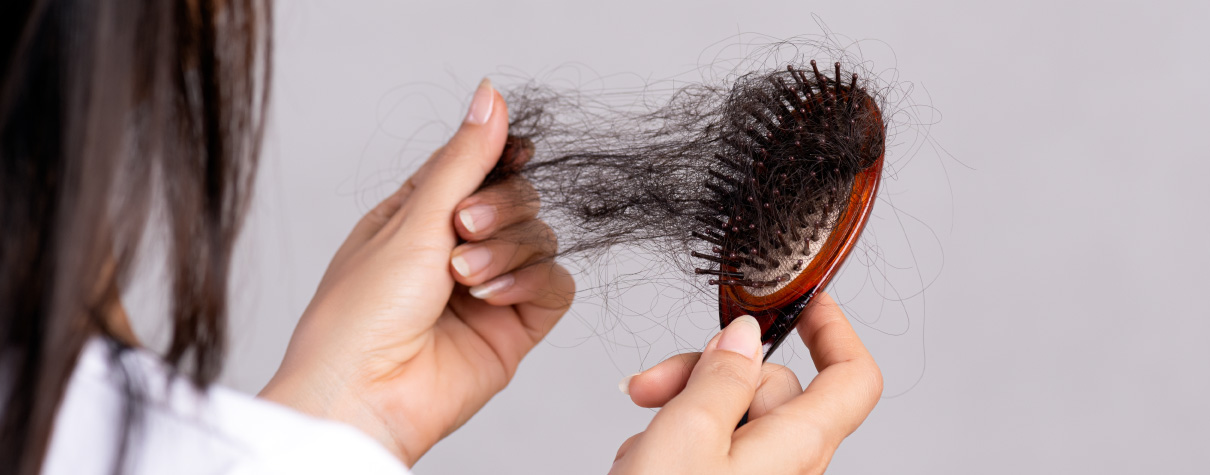
If you notice more hair shedding while washing or brushing, but no completely bald spots, you are likely experiencing this type of hair loss.
Female vs. Male Hair Loss
Although they may seem similar, hair loss in men and women behaves very differently. In men, hair loss follows clear patterns such as a receding hairline or thinning at the crown. In women, it tends to be more diffuse, presenting as an overall loss of volume rather than distinct bald areas.
Additionally, the frontal hairline usually recedes in men, while it is generally preserved in women. This difference significantly impacts treatment planning. Female hair loss is also more complex, often involving multiple factors such as hormonal changes, stress, and nutritional issues, which require a more comprehensive diagnosis.
For this reason, treatments—especially hair transplants—must be evaluated more carefully in women.
Non-Surgical Treatments
One of the most common mistakes is assuming that all treatments work the same way or that a hair transplant should be the first option. In reality, choosing the wrong treatment can delay results or even worsen the problem.
1. Minoxidil (topical or oral)
One of the most studied treatments.
How it works:
- Increases blood flow to the follicle
- Stimulates continuous growth
Key point: it works as long as you use it. Stopping treatment may reverse progress.
2. Nutritional supplementation
It doesn’t create new hair but helps correct deficiencies.
Important if you have:
- Iron deficiency
- Low vitamin D levels
- Hormonal imbalances
3. Low-Level Laser Therapy (Red Light Therapy Cap)
Devices that stimulate the hair follicle using light.
Benefits of the red light cap:
- Improves hair quality
- Stimulates the follicle in early stages
- Helps slow down progressive thinning
- Enhances the results of other treatments
It is an excellent complementary option, but it is usually not sufficient on its own in advanced cases.
When Should You Consider a Hair Transplant?
A hair transplant can be an excellent solution—but only when it is properly indicated. In women, performing it at the wrong time or without an accurate diagnosis can lead to unnatural or insufficient results.
Consider a transplant if:
- Hair loss is stable (not rapidly progressing)
- There are areas with permanent loss (no active follicles)
- You have tried treatments without sufficient success
- You have a strong donor area (back or sides of the scalp)
In women, a transplant is not the first option in most cases… but it can be the best one when correctly indicated.
If you notice that your hair has lost volume, feels thinner, or is shedding more than usual, it’s important not to ignore it.
In many cases, acting early allows the issue to be resolved with simpler treatments. However, when there is already permanent hair loss, there are also effective solutions such as a hair transplant.
The most important thing is understanding what is happening in your specific case. Not all types of hair loss are treated the same way, and choosing the right approach from the beginning can make all the difference in the final result.
Schedule your consultation at HairFix and discover what’s causing your hair loss and which treatment is right for you—with or without a hair transplant.